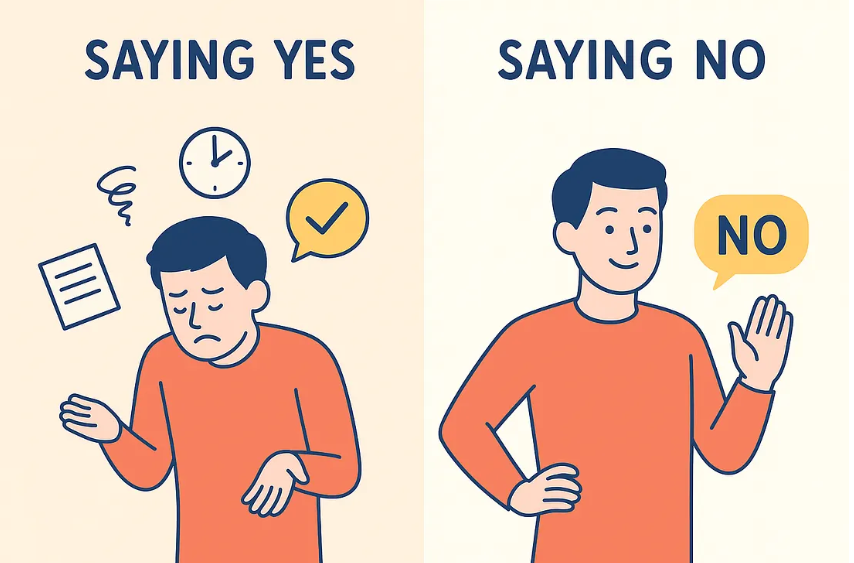
Learn to say NO – without fights, without guilt and without regrets!

I used to be one of those individuals who felt compelled to please others. I often agreed to requests when I knew I should have declined. Consequently, I would feel frustrated with myself for acquiescing. When you agree instead of refusing, people tend to return, operating under the assumption that your affirmative response means they can rely on you, as you wished to avoid upsetting them. Nothing appears in your life that you did not consciously invite.

So, how can you establish boundaries for yourself?

I struggled with setting boundaries, even with strangers. What I discovered was that people continued to approach me because I wanted them to perceive me as a kind person, someone they could ask for anything and expect a positive response. I would agree to whatever was requested. Often, this led to feelings of anxiety and concern about various matters, while the other person might not even be considering my feelings. Thus, I learned to clearly define my own boundaries regarding what I was willing to do, whether it involved giving my money, time, or services. I had the authority to choose whom I wanted to assist. By doing so, I realized that receiving numerous requests each week does not obligate me to fulfill every one of them. Just because there are demands on my time does not mean I must respond affirmatively. I have the power to decide, as I am the architect of my own fate and the captain of my soul. This understanding profoundly transformed my life, as I was no longer dictated by the desires of others but instead took control of my own path, making decisions based on what I believed to be the next appropriate step for myself.

The primary reason for agreeing to trivial matters in life is often rooted in fear.

  • Fear of missing out
  • Fear of letting someone down
  • Fear of the only one to say NO
  • Fear of making the wrong decision

In India NO isn’t just a word, its personal

It indicates a lack of concern or a degree of selfishness. A simple NO can lead to feelings of guilt, emotional manipulation, or tears. Therefore, how can you decline without causing them pain?

5 strategies to decline without causing hurt

1. The gentle NO approach

Begin with a yes, then clarify why you cannot participate – Instead of stating "NO, I cannot join you to play," say, "I would be delighted to join for play, but I have a presentation tomorrow that requires my preparation."


Your mind is conditioned to respond negatively to rejection. When someone hears a swift NO, their Amygdala (the emotional center of the brain) activates defense mechanisms. This can evoke feelings of hurt, disappointment, or even resentment. However, when you initiate with a positive statement like "I would love to," their brain first registers acceptance, which diminishes their emotional resistance.

2. Frame NO in a way that resembles yes

Individuals not only dislike rejection but also have an aversion to uncertainty.

A direct NO, such as "I cannot," feels akin to slamming a door in their face. They may feel overlooked, but if you present an alternative, their focus shifts to that option rather than feeling odd about the rejection.

For instance: "Playing sounds wonderful, but I have a presentation tomorrow. How about we play this weekend instead?"

In this case, by offering an alternative, their focus transitions from rejection to possibility. You are not rejecting them but rather rescheduling.

3. The buffer zone technique

In certain situations, easy alternatives may not be available. Instead of abruptly saying NO, you might say, "Can we discuss this after my meeting or once I have prepared for my presentation?"

This simple phrase creates a moment for you to contemplate the importance of your NO and allows them to calm down.

People tend to react more emotionally in the heat of the moment. By providing them with space and time, their immediate disappointment diminishes, enabling them to process the situation more rationally. By the time you deliver your NO, they are significantly less likely to respond dramatically.

4. The Empathy NO Method

Sometimes, when someone makes a request, outright rejection can come across as harsh. This is the moment to demonstrate empathy. Rather than simply declining, express sincere regret.

For instance: I truly wish I could join you all for some fun and quality time, but regrettably, I have a deadline this week, and I feel bad for missing out.

By showing that you genuinely care, you can transform their emotional response from "How could you say NO" to understanding that you genuinely wanted to participate but are unable to. Empathy diminishes resistance. While they may still feel disappointed, they will not feel dismissed.

5. The Outsource Method

When saying NO seems impossible, or if you believe that no matter how you phrase it, they will take your NO personally, clarify that the situation is beyond your control.

For example: I would love to help, but my manager has assigned me additional work, leaving me with barely any time to breathe. When the reason is external, such as a boss, work obligations, or health issues, and they realize that you cannot change the situation, they are less likely to argue with you. The frustration shifts from you to the circumstances, making it easier to say NO.


When you encounter these tactics, they may appear to be manipulative; however, that is not the case. Declining an offer is not an act of selfishness, but rather a means of establishing a boundary. Conversely, if you agree to everything, you risk overextending yourself and developing feelings of resentment, ultimately leading to exhaustion from attempting to satisfy everyone. Establishing a boundary is not inherently wrong, but doing so in a manner that causes harm to another is indeed inappropriate. These strategies assist you in safeguarding your time, energy, and mental well-being without jeopardizing any relationships. These approaches are not manipulative. They represent a more intelligent method of declining without feelings of guilt, conflict, or regret.

Here are seven suggestions to ensure that remote or hard-to-reach employee’s feel included and appreciated:

Recent Blog

We Provide Best Solution

Learn to say NO – without fights, without guilt and without regrets!

Learn to say NO – without fights, without guilt and without regrets!

Learn to say NO – without fights, without guilt and without regrets! I used to be one of those individuals who felt compelled…

We don’t mature through age; we mature in awareness.

We don’t mature through age; we mature in awareness.

We don’t mature through age; we mature in awareness. Here are some qualities to understand self maturity level. 1. Embrace the reality Acceptance…